Salt Lake Swapped Sparks for Swarms. That’s Bigger Than the Fourth of July.
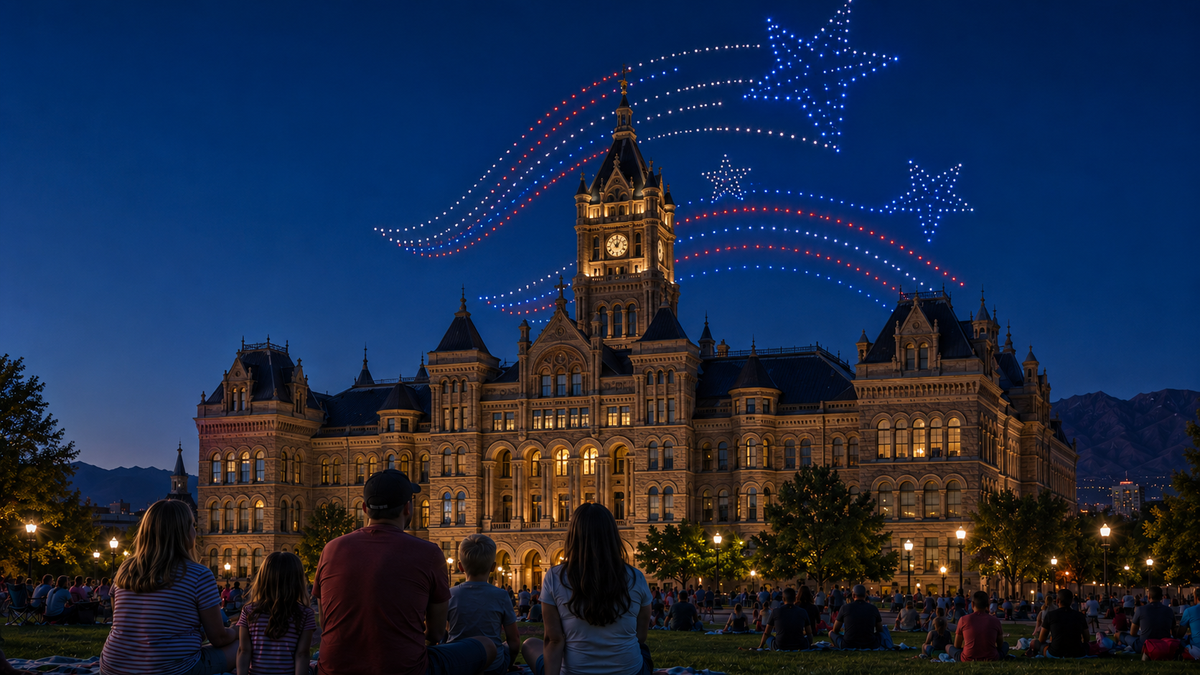
Salt Lake City’s Fourth of July celebration looked different this year.
Instead of traditional fireworks, the city leaned into a 500-drone show at Jordan Park for America’s 250th birthday. The shift was not just about spectacle. It came during a statewide personal fireworks ban tied to wildfire risk, hot dry conditions, and ongoing concern for first responders and public lands.
That makes Salt Lake a useful case study for the drone industry.
Drones are no longer just tools for pilots, photographers, and public safety teams. They are becoming part of how cities celebrate, manage risk, and rethink old traditions.
Flight-Ready Breakdown
What Changed
Salt Lake City hosted its America 250 Drone Show at Jordan Park on Friday, July 3, with food trucks, live music, and a 500-drone light show Salt Lake City Events.
The timing mattered.
Utah was under a temporary statewide restriction on personal fireworks through July 5 because of wildfire conditions Utah Governor’s Office. Salt Lake City officials also confirmed that personal fireworks were prohibited throughout the city during the restriction period Salt Lake City Council.
So the drone show was not just a cool replacement.
It was a practical answer to a local problem: how do you celebrate when sparks are a risk?
Who It Affects
This matters for:
- Local drone pilots
- Event organizers
- City governments
- Public safety teams
- Drone show companies
- Families looking for safer holiday events
- Small UAS businesses watching future demand
Salt Lake is not alone. Cities across the West are under more pressure to reduce fire risk, limit smoke, and still give people a shared public moment. Drone shows fit that gap.
They do not replace every part of fireworks. They are quieter, cleaner, programmable, reusable, and easier to theme around a story. For America 250, that matters. A drone show can literally draw history in the sky.
Why It Matters
For anyone with an aviation or Air Force background, the contrast is hard to miss.
On one side, Utah had organized military flyovers as part of America 250 celebrations. On the other side, Salt Lake used organized drone formations to close the night. Different aircraft, different missions, same principle: airspace only works when it is planned.
That is the part casual observers miss.
A drone show is not just “a bunch of drones in the sky.” It is choreography, risk management, airspace coordination, battery planning, launch-site control, crew discipline, weather calls, and crowd safety.
That is why this story belongs in The Drone Pilot Brief.
Because the public sees the lights.
Pilots should see the operation.
The Local Takeaway
Salt Lake City has a natural reason to become a stronger drone-show market.
We have dry summers. We have wildfire risk. We have mountain terrain. We have air-quality concerns. We have neighborhoods close to foothills and open space. And we have a community that still wants big shared moments.
That makes drone shows more than entertainment here.
They are part of a changing civic toolkit.
For drone businesses, this points toward a broader opportunity: events, public communication, tourism, local storytelling, and safer celebration planning. Not every pilot is going to fly drone shows, but every pilot can learn from how professional these operations have to be.
Before You Fly
A public drone show is not an invitation to launch your own drone.
If you are near a city event, stadium, emergency scene, wildfire, airport, or large crowd, check the airspace before flying. Review NOTAMs, TFRs, LAANC availability, local restrictions, and event rules. The FAA reminds pilots that Temporary Flight Restrictions can apply to major events and that drone operators are responsible for checking before flight FAA.
For local pilots, the rule of thumb is simple:
If the sky is part of the event, stay out of it unless you are part of the operation.
The Takeaway
Salt Lake City’s Fourth of July drone show was more than a fireworks substitute.
It was a signal.
The future of drones will not only be mapping, inspection, real estate, or public safety. It will also be civic storytelling, safer celebrations, and public trust.
That is good news for the industry, but only if pilots treat the airspace with the same professionalism the moment deserves.
The sparks may be fading.
The sky is not.
Sources
- Salt Lake City: America 250 Drone Show
- Salt Lake City Parks: Skip the Sparks, Celebrate Safely at a Salt Lake City Drone Show
- Utah Governor’s Office: Temporary Statewide Fireworks Restrictions
- Salt Lake City Council: Statewide Fireworks Restrictions Statement
- FAA: Temporary Flight Restrictions for UAS Operators